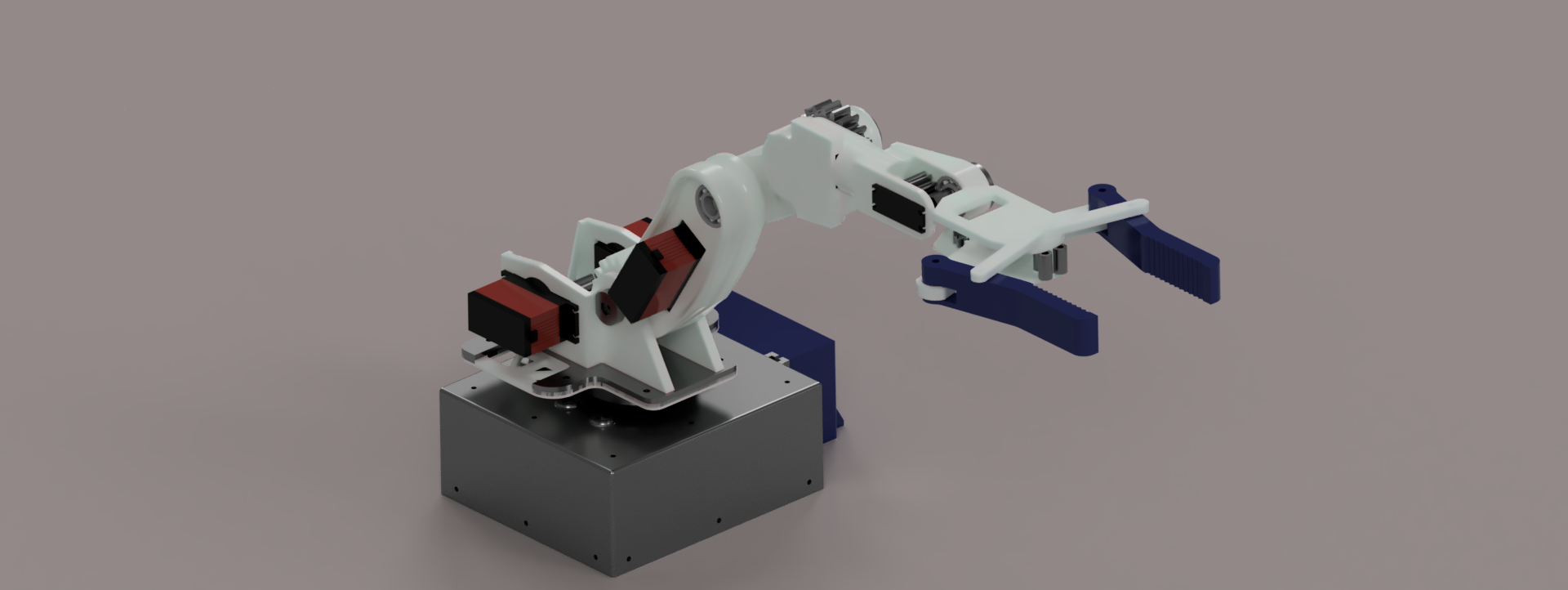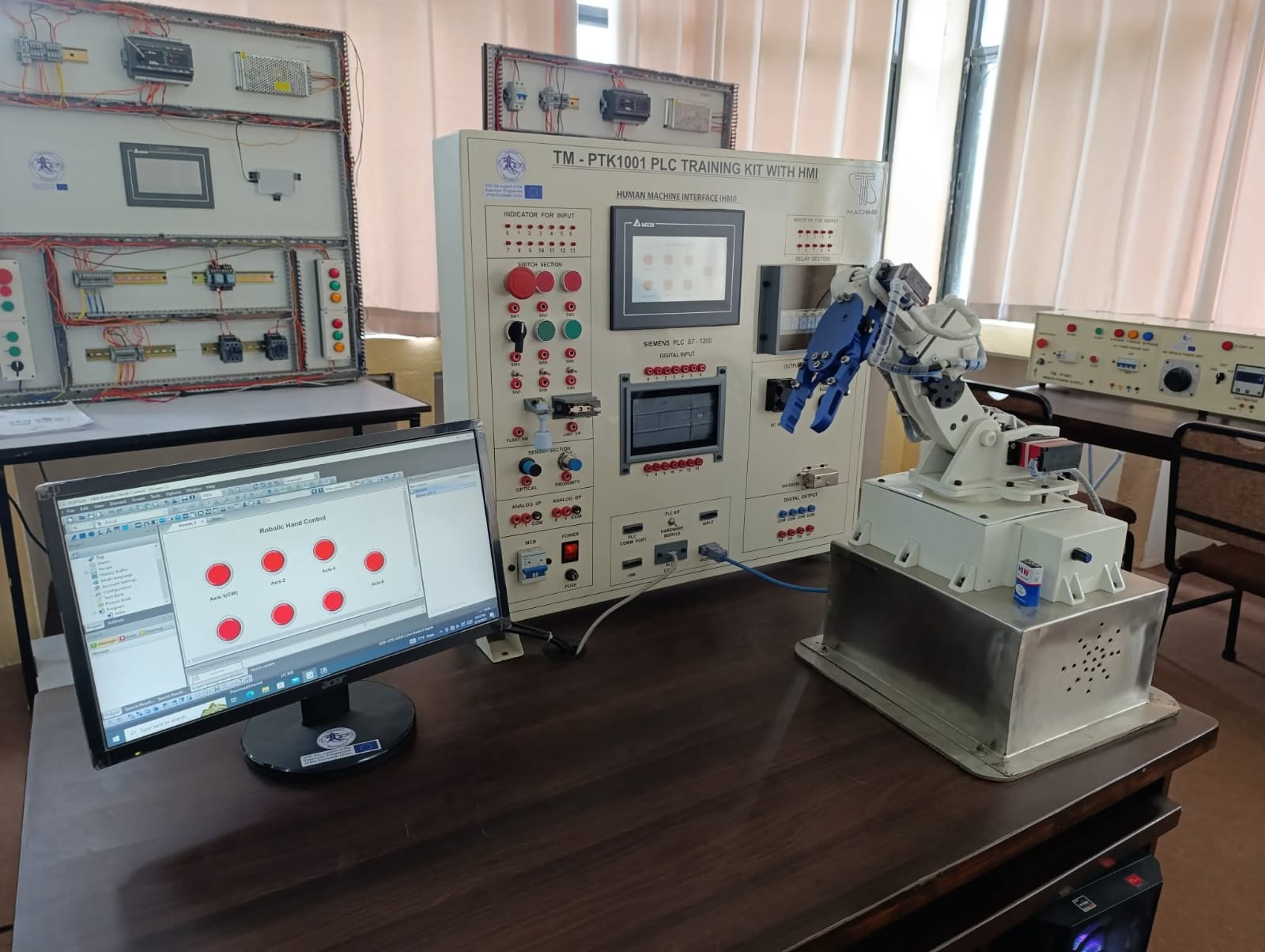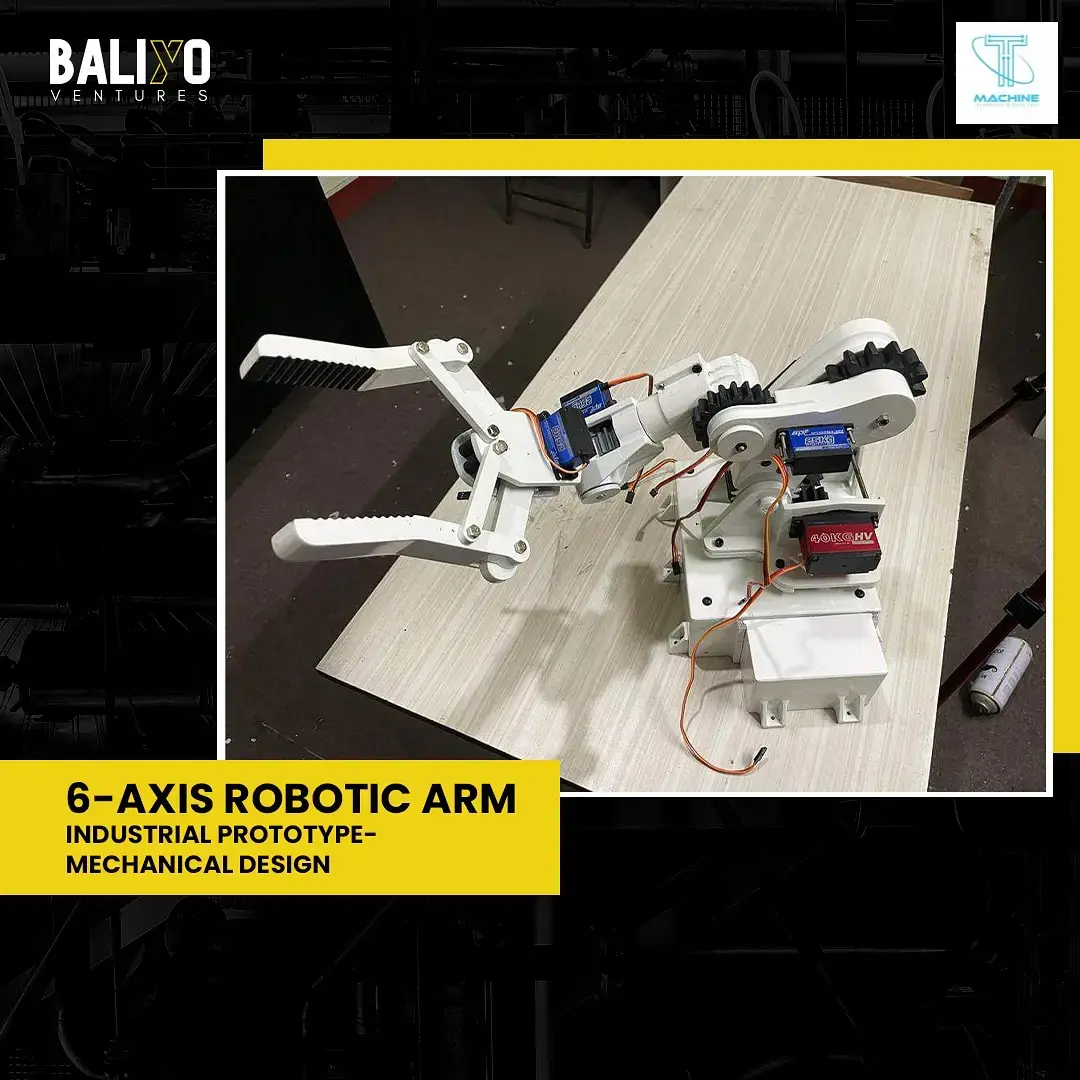
This project brings robotics education to life with a compact, affordable, desktop-sized robotic platform designed specifically for students and hobbyists. Rather than relying on abstract theory and textbook diagrams, this system puts a real, working robot directly into the hands of learners, allowing them to experience the principles of programming, kinematics, and automation through direct, tangible experimentation.
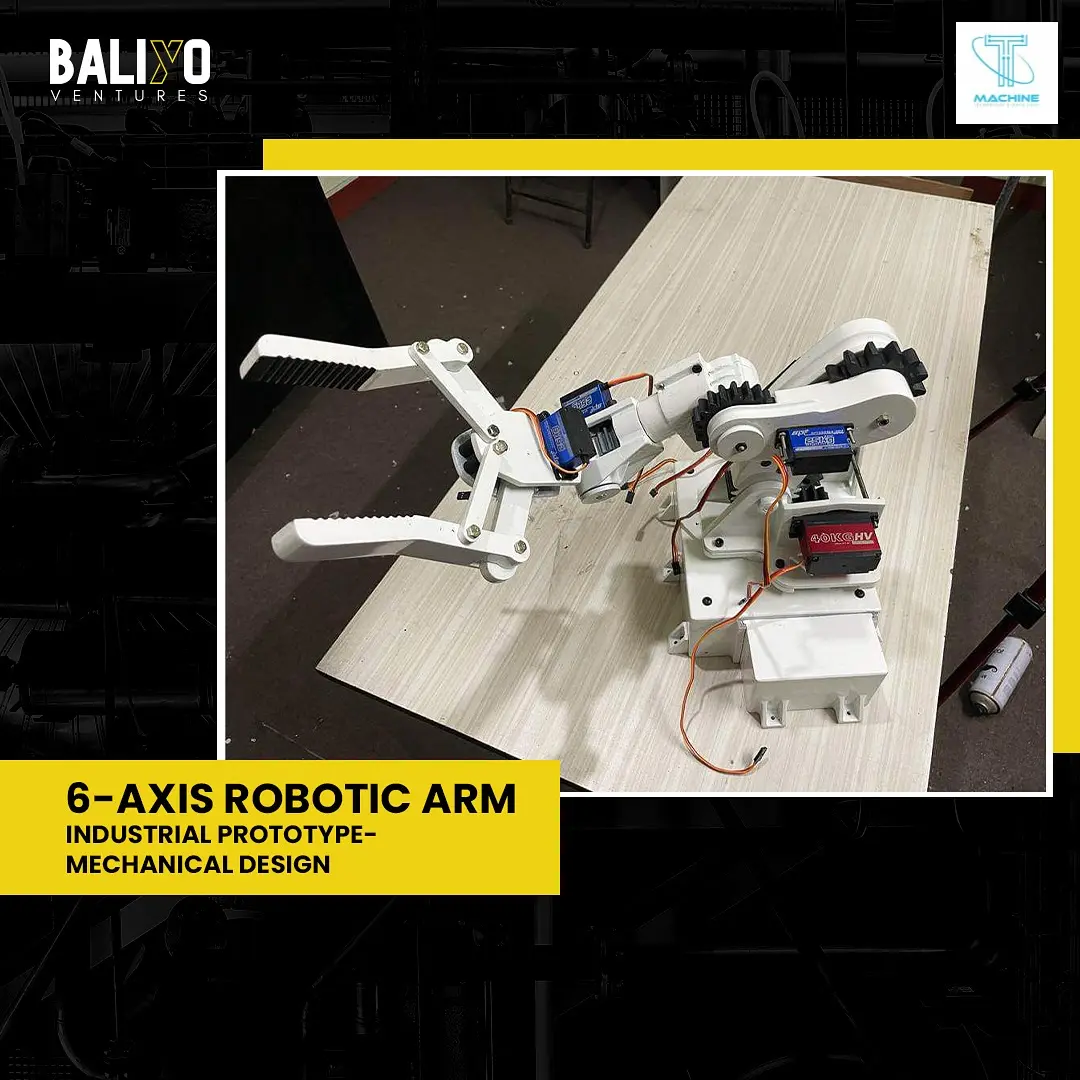
The robot features a full six axes of movement, giving it the flexibility and range of motion found in industrial robotic arms. Its design includes four powered joints that drive the primary motions, enabling smooth, precise positioning across a meaningful workspace. Despite its professional-grade capabilities, the platform remains small enough to sit safely on a standard desk or lab table, making it accessible for classrooms, maker spaces, and individual learners alike.
At its core, the robot is built for pick-and-place operations — the fundamental task that underpins countless real-world automation applications. Students can program the arm to pick up small objects, move them through space, and place them with accuracy, learning the basics of trajectory planning, coordinate systems, and inverse kinematics in the process. Every movement is a lesson: how joint angles relate to end-effector position, how speed and acceleration affect precision, and how to sequence commands to achieve a desired outcome.
What makes this platform truly powerful for education is its openness and expandability. The robot is fully programmable through an intuitive interface that supports multiple levels of complexity, from beginner-friendly visual coding to advanced text-based languages. Students can start by recording and replaying simple motions, then progress to writing their own control algorithms, implementing inverse kinematics solvers, and experimenting with path optimization.
The system is also designed to grow with the learner. Additional joints can be added to extend the robot's range of motion, while interchangeable end-effectors — such as grippers, suction cups, magnetic tools, or even sensors — open up a world of advanced tasks. Students can customize their robot for specific challenges, from sorting objects by color to performing delicate assembly operations, or even integrating computer vision for autonomous object recognition and grasping.
This flexibility transforms the platform from a fixed-purpose device into a true learning ecosystem. As students' skills develop, the robot evolves alongside them, offering fresh challenges and new possibilities at every stage. It encourages experimentation, problem-solving, and creative thinking — qualities that no textbook alone can cultivate.
Beyond the technical skills, the platform fosters a deeper understanding of automation and its real-world implications. Students gain insight into how robots are used in manufacturing, logistics, and research, and they develop the confidence to design, build, and control their own automated systems. The hands-on nature of the experience ensures that concepts like joint coordination, workspace mapping, and error handling are not just memorized but truly internalized.
The affordability of the platform is a deliberate and essential feature. Robotics education has long been hindered by the high cost of equipment, limiting hands-on opportunities to well-funded institutions. This system breaks down that barrier, making robotics accessible to community colleges, high schools, and even individual learners working from home. By lowering the cost of entry without compromising functionality, it democratizes access to a field that is increasingly vital to the future of work and innovation.
In essence, this desktop robotic platform is more than a teaching tool — it is a gateway. It invites students to move beyond passive learning and into active creation, to ask "what if" and then find out, to make mistakes and learn from them in real time. It builds not just technical competence, but also curiosity, resilience, and a lifelong enthusiasm for engineering and automation. For anyone beginning their journey into robotics, this is where the adventure truly starts.